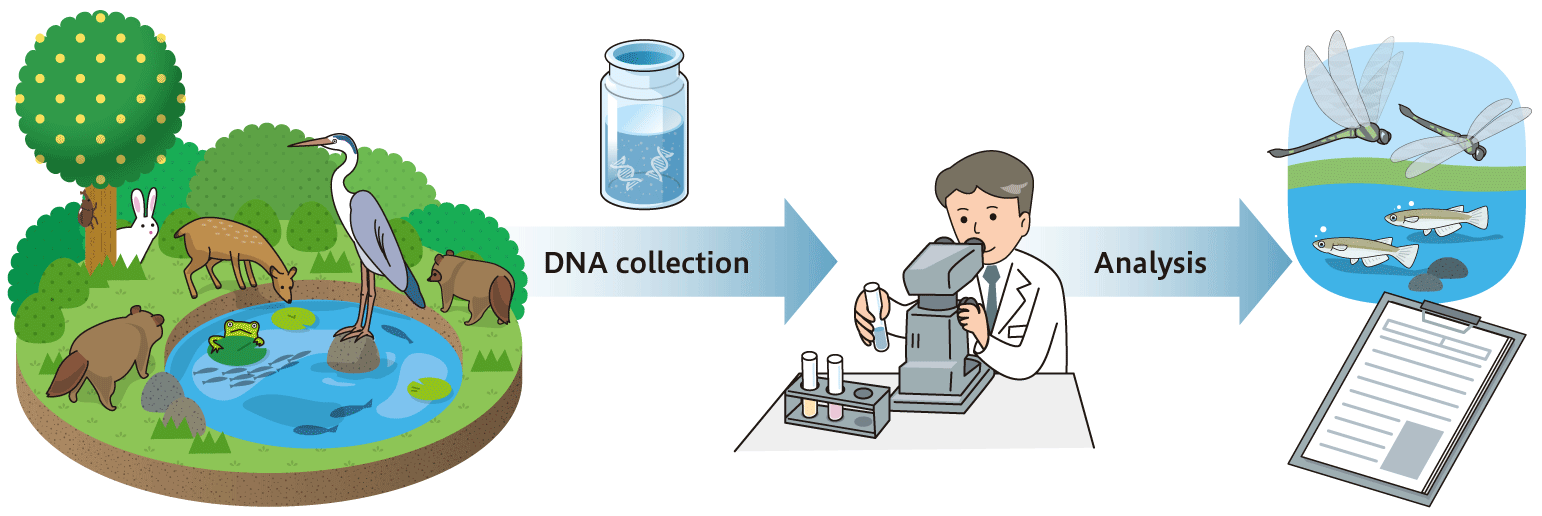
Efforts to Assess and Conserve Biodiversity through Environmental DNA Monitoring
What is Environmental DNA Monitoring?
AdvanSentinel Inc.’s Technology Development and Social Implementation
Demonstration Experiment at Aburahi Botanical Gardens
The Aburahi Botanical Gardens, managed by SHIONOGI, cultivates more than 1,000 species of plants, including endangered and rare species. However, how the rich vegetation of the garden influenced the conservation of endangered species in the surrounding satoyama (traditional rural landscape) remains unclear.
To address this, SHIONOGI, in collaboration with AdvanSentinel Inc., conducted a biological survey using eDNA analysis technology. This pilot study was launched to better understand and analyze biodiversity conservation at the Aburahi Botanical Gardens.
Survey Results and Future Outlook
As a result of the eDNA monitoring conducted thus far, DNA from 65 species was detected at observation points in and around the Aburahi Botanical Gardens. These included the southern medaka, listed as increasingly endangered on the Koka City Red List, as well as the Japanese fire-bellied newt, Schlegel’s green tree frog, and the four-spotted dragonfly.
These findings indicate that the Aburahi Botanical Gardens may serve as a habitat supporting a rich ecosystem that includes endangered flora and fauna. We will continue to collect and analyze eDNA and use the insights gained in biodiversity conservation efforts.